
Books Worth Reselling? Check These 6 Types Before You Buy
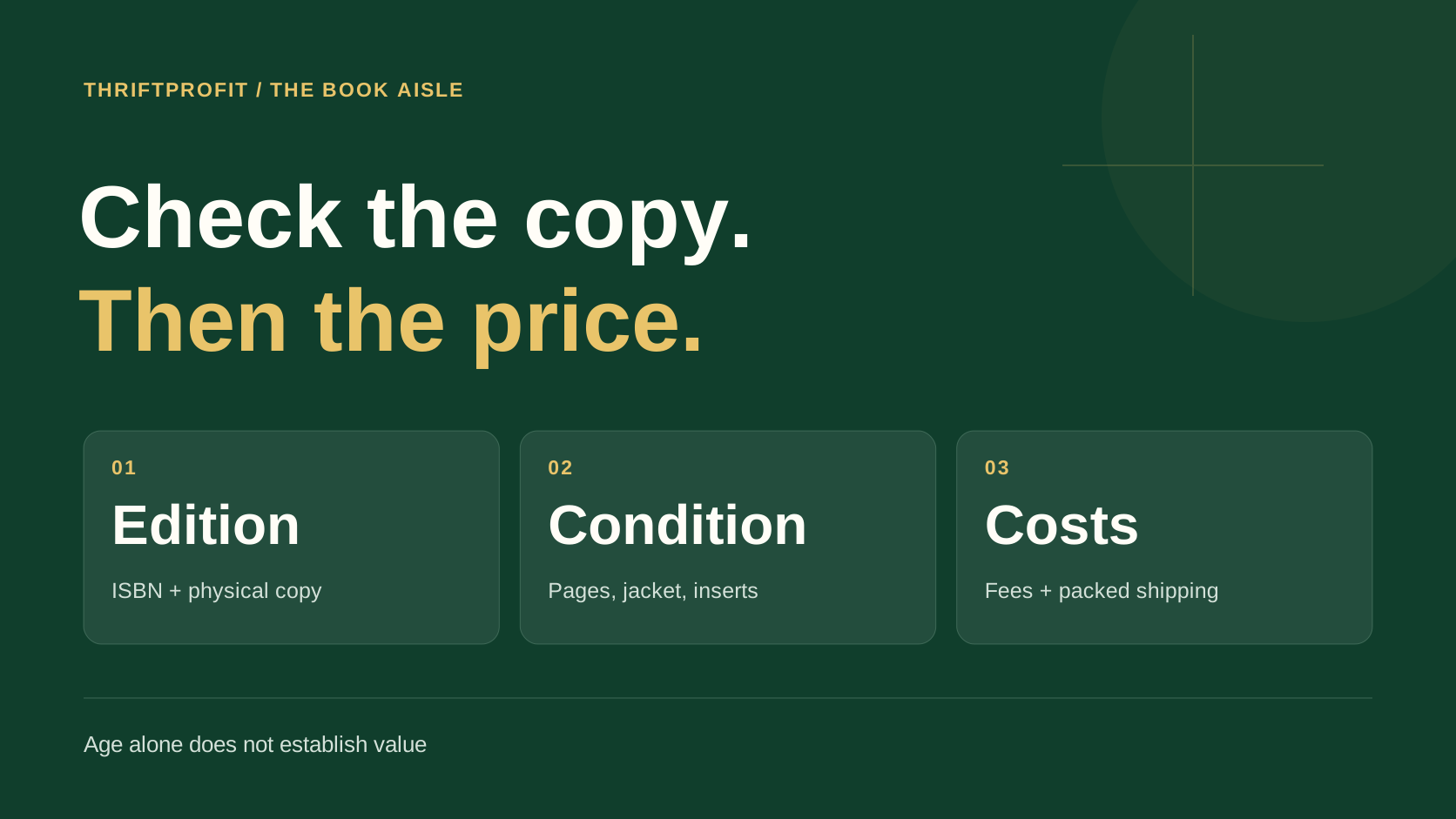
Books are worth reselling when the exact edition has buyer demand and the likely sale covers purchase cost, fees, packing and postage. Investigate textbooks, technical manuals, specialist nonfiction, collectible editions, complete sets and selected out-of-print titles. Age, an ISBN scan or a high asking price alone does not establish value.
The expensive mistake in the book aisle is buying the whole stack because one title has a $90 listing. The useful find is a specific copy with a defensible selling price and enough room for costs.
Start by treating every promising book as a research question. A hardcover, old date or impressive original retail price is a clue to investigate, not a buy signal.
Six types of books worth checking
This is an editorial shortlist, not a ranking backed by category sales data. Each type has a different reason to investigate and a different reason to pass.
| Type | What to research | What can remove the value |
|---|---|---|
| Textbooks | Exact edition, ISBN and format; demand for that version | Superseded edition, missing supplements, unverifiable access-code status |
| Repair and technical manuals | Exact machine, model, revision or software version | Wrong application, missing diagrams, outdated instructions |
| Specialist nonfiction | A named subject, author or recognized reference edition | Too few buyers, common reprints, shipping-heavy format |
| Collectible editions | Printing, binding, jacket and documented signature where relevant | Misidentified first printing, missing jacket, unsupported signature claim |
| Complete series and sets | Matching editions and every required volume | Missing books, mixed formats, costly combined postage |
| Selected out-of-print titles | Evidence that buyers still want this particular edition | Scarcity without demand, later substitutes, unrealistic asking prices |
Cookbooks, art books and local histories can fit several rows. They still need title-level research. “Out of print” describes availability; it does not guarantee buyers.
Check the ISBN, then check the physical copy
The International ISBN Agency explains that different formats and substantially revised editions require distinct ISBNs. Use the number to narrow the search, then verify the title page and copyright page.
Record:
- Title, author and publisher.
- ISBN where present, edition and printing information.
- Hardcover, paperback or other binding; language and format.
- Presence and condition of a dust jacket, inserts, maps or supplements.
- Markings, odors, stains, loose pages and repairs.
An ISBN identifies a publication, not the history or condition of an individual copy. Do not use it alone to claim a first printing or an authenticated signature. For an older book without an ISBN, search title, author, publisher and date together.
AbeBooks' valuation guidance emphasizes matching copies closely and considering edition, condition and dust jackets. Its listing prices are asking prices. Use them to understand available copies, not to claim a completed transaction.
How do you check whether a used book will sell?
Search the exact edition in completed-sale research, then inspect the results individually. eBay Product Research provides sold-price evidence; the sold-comps guide explains how to filter mismatches.
Separate individual copies from lots, signed from unsigned copies, and complete sets from partial sets. Keep ex-library copies and damaged books distinct when condition materially changes the comparison.
If there are no close recent sales, try a longer period and record it. Do not treat no current competitors as proof of demand. It can also mean that very few buyers search for the book.
For a common title, a low buyback offer can be another piece of information, but it is a conditional offer rather than a completed retail sale. Check the buyer's edition, condition and shipping requirements before relying on it.
A $24 sale is not $24 profit
Illustrative example, USD; no current fee or shipping quote. Suppose you model one book at $24 with shipping included:
| Cost worksheet | Amount |
|---|---|
| Expected sale, including shipping | $24.00 |
| Purchase cost | −$3.00 |
| Assumed selling fees | −$4.00 |
| Assumed postage | −$5.00 |
| Packing materials | −$0.75 |
| Profit before tax, labor and overhead | $11.25 |
At a $15 sale, holding those expense assumptions constant only to illustrate sensitivity, the remainder is $2.25. Actual percentage-based fees would also change. That difference is why matching the edition matters before buying.
Use this purchase ceiling:
Maximum buy price = conservative buyer-paid total − selling fees − postage − packing − preparation − desired profit buffer.
Verify your platform's book-category fees and current shipping quote. Our general calculator is oriented toward clothing marketplace assumptions; do not silently apply a clothing fee preset to a book sale. The worksheet above lets you enter book-specific costs without that mismatch.
Can you use Media Mail for books?
For US domestic shipments, USPS Media Mail rules include books with at least eight printed pages and restrict advertising, with specified exceptions. Check the actual contents before choosing the service; not everything shelved beside books qualifies.
Weigh the packed parcel, not only the book. Include protective materials, check the current rate and consider the buyer's delivery expectations. This guide does not quote a postage rate because weight, service and rules must be checked for the shipment.
Heavy reference books and multi-volume sets especially need a packed-shipping estimate before purchase. “Buyer pays shipping” does not eliminate your need to calculate and charge it correctly.
What should make you pass on a book?
Editorial pass signals: uncertain edition, missing pages or essential inserts, condition you cannot describe confidently, unresolved signature claims, insufficient comparable evidence, or too little money after costs.
A common novel is not automatically worthless; it may work in a well-matched bundle. A rare-looking manual is not automatically valuable; it may cover equipment nobody is maintaining. Let the specific evidence decide.
Save a one-book research note
Write down edition → condition → comparable sales → packed shipping → total costs → buy ceiling. Research one copy all the way through before applying the same reasoning to the rest of the shelf.
Save the free sourcing checklist, learn the sell-through calculation, or compare books with other departments in the category research guide.
How we checked this
We checked the International ISBN Agency, AbeBooks’ valuation guidance, USPS Media Mail rules and eBay Product Research. The six book types are research suggestions, not a measured profitability ranking. Every dollar amount below is hypothetical.
- Verified reference guidance
- Edition and format identification, collectible condition factors and shipping eligibility are linked to primary sources.
- Editorial shortlist
- Book types are candidates for research; no category is presented as guaranteed to sell.
- Illustrative calculation
- The worked example uses assumed costs and is not a current fee or postage quote.
Sources
- ISBN assignment
International ISBN Agency · checked September 21, 2026
Different formats and substantially revised editions require different ISBNs.
- Finding the value of old books
AbeBooks · checked September 21, 2026
Matching comparable copies and assessing edition, condition and dust jackets; marketplace asking prices are not completed sales.
- Media Mail and Library Mail: Content standards
USPS Postal Explorer · checked September 21, 2026
Eligibility of books with at least eight printed pages and applicable advertising restrictions.
- Product Research
eBay · checked September 21, 2026
Researching completed-sale prices rather than relying on active asking prices.
Frequently asked
- What types of books are worth reselling?
- Research textbooks, technical manuals, specialist nonfiction, collectible editions, complete sets and selected out-of-print titles. Buy only after checking the exact copy’s demand, condition and likely net return.
- Does an ISBN tell me what a book is worth?
- No. It helps identify a publication and format. It does not establish the condition, signature, completeness or collectible printing of the copy in your hand, and it does not prove anyone will pay the listed price.
- Are old books always valuable?
- No. Age alone does not establish demand. Match title, publisher, edition, printing and condition with appropriate comparisons; include the dust jacket when relevant.
- Can I ship every book with USPS Media Mail?
- Do not assume eligibility. USPS has content requirements, including the eight-page minimum for books and advertising restrictions. Check the contents and current USPS rules before choosing the service.
- Can Thrift Snap scan book ISBNs?
- Thrift Snap is focused on clothing, shoes and accessories. This guide is a manual book-research workflow, not a claim that the app scans ISBNs or appraises collectible books.