
Sold Price vs Asking Price: The $100 Listing Trap
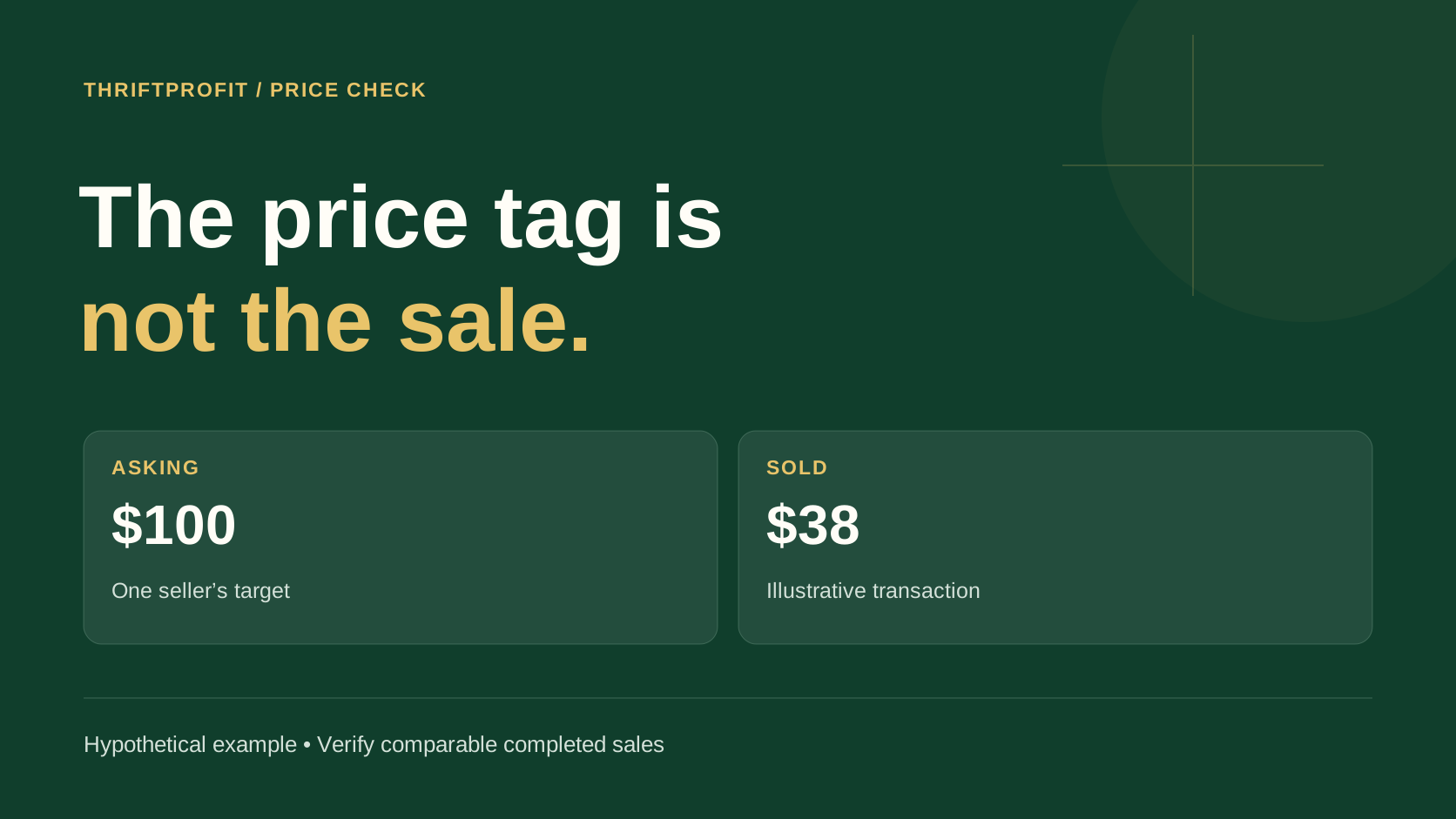
An asking price is what a seller wants; a sold price records a completed transaction. For resale research, start with recent sales of the same model in comparable condition, check accepted offers and shipping, then subtract your costs. An expensive active listing alone does not establish what your item is worth.
A jacket costs $12 at the thrift store. You find one online for $100. That feels like an $88 opportunity—until comparable buyers are paying $38 and you still have to ship it. Those numbers are an illustration, but the mistake is easy to repeat: treating someone else's price tag as proof of demand.
What is the difference between sold price and asking price?
| Number | What it tells you | How to use it |
|---|---|---|
| Asking price | The seller's current target | Understand the competition a buyer sees |
| Sold item price | The recorded transaction amount for the item | Build a comparable-sale range |
| Buyer-paid total before tax | Item price plus shipping charged to the buyer | Compare free-shipping and paid-shipping offers |
| Net proceeds | What remains after selling expenses | Calculate what the sale contributes before acquisition cost |
| Profit before tax | Proceeds minus acquisition and other included costs | Decide whether sourcing the item makes sense |
Keep those columns separate. A screenshot saying “sold for $100” still does not show what the seller earned after purchase cost, fees, postage or returns.
How do you find reliable eBay sold comps?
A sold comp is a comparable completed sale. The useful word is comparable: a different model, bundle or condition can make a real sale irrelevant to your item.
eBay Product Research includes actual accepted Best Offer prices and lets sellers research up to three years of sales. Use a recent window first; older results can help with scarce items, but record their dates.
Use this editorial workflow:
- Identify the exact item. Write down brand, model or style code, size, material and defining features. For books, use the edition and ISBN checks.
- Keep the search consistent. Match condition, market, currency and selling format. Exclude new items if yours is used.
- Read the listing behind the number. Check defects, accessories, bundles and whether shipping is included. A single jacket and a three-jacket lot are different products.
- Record several close matches. Five to ten is a practical starting target, not a statistically representative sample. If only two match, state that uncertainty rather than padding the set.
- Write down exclusions. “Wrong model,” “new with tags,” “damaged” and “bundle” are useful reasons. “Price too low for my plan” is not.
The $100 listing trap: a worked comparison
Illustrative example, USD. Assume these five hypothetical sales match your jacket's model, size and condition. Each includes shipping, so the buyer-paid totals are directly comparable.
| Comparable sale | Item price including shipping |
|---|---|
| A | $32 |
| B | $35 |
| C | $38 |
| D | $40 |
| E | $45 |
The median is $38, the middle result when ordered by price. The $100 active listing belongs in the competition column; it is not a sixth sale. The $32–$45 spread is an observed range within this fictional example, not a confidence interval for a real jacket.
Now suppose you model a $38 sale with $6 in selling fees, $8 postage, $1 packaging and a $12 purchase cost:
$38 − $6 − $8 − $1 − $12 = $11 profit before tax, labor and overhead.
The $6 fee is an assumed expense, not a quoted marketplace rate. Replace every input with your own costs and check the reseller fee guide. If you reserve another $3 for potential problems, your planning buffer leaves $8.
Which sold comps should you leave out?
Exclude mismatches consistently. Common traps include a rare color mixed with a common one, a signed copy mixed with an unsigned book, replacement parts mixed with working equipment, and a pristine item mixed with a damaged one.
For a Best Offer result, do not silently substitute the original price when the accepted amount is unclear. Mark it unknown until verified. For a bundle, do not divide by item count unless the pieces are genuinely comparable in value.
A high sale should trigger a closer look, not an automatic deletion. It may reveal a feature you missed. Likewise, unusually low sales may reflect damage, incomplete accessories or a listing error. Document what you can actually establish.
What if there are no close sold listings?
“No comps” means limited evidence. It can mean scarcity, weak demand, a poor search query or the wrong identification. Try a model number, alternate name or longer date window, and keep any older comparisons separate.
Do not promote the highest asking price into a valuation to fill the gap. A reasonable sourcing decision may be to pass, buy only within a small research budget, or ask a specialist before spending more.
Price also does not tell you how quickly something will sell. Pair the range with a sell-through check and your available storage time.
Save this sold-comps checklist
Before paying, answer six questions:
- Can I identify the exact model or edition?
- Are these completed sales of comparable items?
- Have I checked offers, condition and bundles?
- Am I comparing the same shipping basis?
- Does a conservative sale cover all my costs?
- Is there enough demand for the time I can wait?
Save the free sourcing checklist for your next trip. Then use the pricing workflow to turn a comparable range into a listing price.
How we checked this
We checked eBay Product Research documentation. The comparison method is editorial guidance; every dollar amount in the worked example is hypothetical, not an observed sale or a valuation.
- Verified tool feature
- eBay documents actual accepted-offer prices in Product Research.
- Illustrative calculation
- Example prices and costs teach a method; they are not marketplace observations.
Sources
- Product Research
eBay · checked September 21, 2026
Actual sold prices, including accepted Best Offers, and available research periods.
Frequently asked
- Is asking price the same as market value?
- No. An asking price shows one seller’s target. Comparable completed sales provide better evidence of what buyers have paid, although condition, timing, shipping and selling costs still matter.
- How do I find the actual eBay Best Offer price?
- Use eBay Product Research to check the accepted transaction price. If an ordinary sold result indicates Best Offer accepted but does not disclose the amount, do not treat the original asking price as confirmed.
- Are completed listings the same as sold listings?
- No. A listing can end without selling. When researching prices, check the sold status rather than assuming every completed listing represents a purchase.
- Should I include shipping when comparing sold prices?
- Record item price and buyer-paid shipping separately, then compare the combined amount before tax. Deduct your own actual shipping expense separately when estimating profit.