
What Is Sell-Through Rate? Avoid the 100% Trap
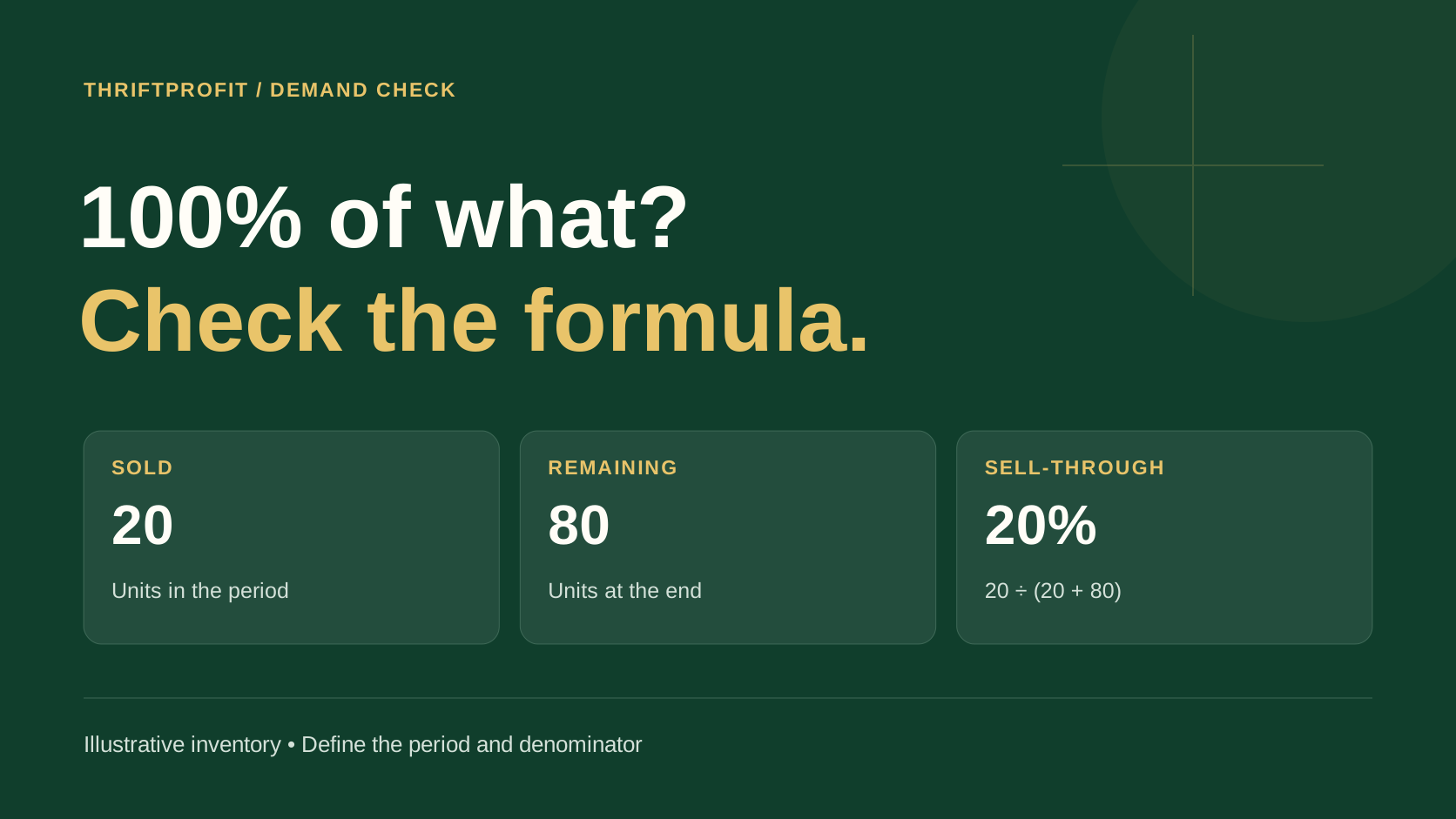
Sell-through rate measures how much inventory sells within a defined period. For your own stock, one formula is units sold divided by units sold plus units remaining, multiplied by 100. The eBay sourcing shortcut sold divided by currently active listings is a different ratio, not your probability of selling.
A reseller calls an item “100% sell-through.” Another calls the same item “50%.” Both may have done the arithmetic correctly. They may simply be dividing by different things.
The useful question is: 100% of what, over which dates? Answer that before buying inventory on the strength of a percentage.
What is the sell-through rate formula?
For an inventory report, Shopify defines sell-through as units sold divided by units sold plus units still in inventory. Express that fraction as a percentage:
Sell-through rate = sold units ÷ (sold units + remaining units) × 100.
Illustrative example: you start with 100 items, sell 20 during 30 days and have 80 left. With no restocking, returns or other adjustments, the rate is 20 ÷ 100 × 100 = 20% over 30 days.
For that simple closed batch, sold divided by starting inventory produces the same answer. Once you restock, remove damaged goods, relist returns or mix batches, describe how those changes enter the calculation. A clear inventory log matters more than a tidy percentage.
Why do eBay sellers use different formulas?
When scouting an item you do not own, you usually cannot follow every seller's starting inventory. Search counts offer a rough way to compare recent activity and current competition. That is a different task from measuring your own stock.
| Metric | Formula | What the denominator represents |
|---|---|---|
| Own-stock sell-through | Sold ÷ (sold + remaining) × 100 | Your stock represented in the report |
| Sold-to-active shortcut | Sold in a chosen period ÷ active now × 100 | Current matching marketplace supply |
| Sold share of combined search counts | Sold ÷ (sold + active) × 100 | A mixture of historical and current search results |
The third calculation resembles the inventory formula algebraically, but marketplace search results are not one tracked inventory batch. It should not be interpreted as a buyer's probability of purchasing your listing.
eBay Product Research also offers its own sell-through metric for periods of 90 days or less. Record the tool and period when you use it; do not assume a hand-calculated search ratio reproduces that metric.
How can an eBay ratio be 100% or 200%?
Illustrative counts, not actual market data: suppose a search has 80 sold results over 90 days and 80 active results today.
- Sold-to-active: 80 ÷ 80 × 100 = 100%.
- Sold share of combined counts: 80 ÷ (80 + 80) × 100 = 50%.
Neither calculation says all current items will sell. The sold results occurred over three months; the active count is a snapshot now.
If there were 160 sold results and 80 active, the first ratio would be 200%. That can be mathematically valid because listings are replenished. It does not mean a 200% chance of selling.
If active results are zero, the sold-to-active ratio is undefined. Record “no active matches” instead of inventing an infinite demand score. If both counts are tiny, check your query before drawing a conclusion.
What is a good sell-through rate for thrift reselling?
There is no useful universal cutoff without a formula, category and period. A 30-day rate and a 90-day rate answer different questions. A seasonal coat and an evergreen replacement part need different context.
Editorial decision guide: use the evidence in combination:
| Research outcome | Next decision |
|---|---|
| Several close sales, manageable competition, adequate net return | Inspect condition and test a small purchase |
| Plenty of sales but little money after expenses | Lower the buy price or pass |
| High potential return but sparse recent sales | Decide how much storage time and uncertainty you can accept |
| Almost no results, or results mostly for another model | Improve identification before buying |
A high ratio cannot repair a bad purchase price. Work through the sold price versus asking price guide before applying a margin assumption.
How do you check demand without misleading yourself?
- Search a specific model, edition or style; filter to comparable condition and geography.
- Use the same search terms for sold and active results. Keep bundles and parts separate.
- Record the sold date range and the date of the active snapshot.
- Note whether counts refer to listings or units. A multi-quantity listing can distort a comparison.
- Compare prices as well as counts. Sales far below your planned price may not support your plan.
- Retain the sample size beside the percentage. One sale is weak evidence, even if the ratio looks impressive.
Repeat the same method when comparing thrift categories. Consistency makes comparisons useful; switching formulas between items defeats the purpose.
Keep a sourcing note you can verify later
Copy this into your notes: item; exact query; market; condition; dates; sold count; active count; calculation used; realistic sale range; total costs; buy/pass reason.
After listing, record your own days to sale, realized proceeds and returns. Those outcomes tell you whether your research method fits your store. A market percentage alone cannot do that.
Save the sourcing checklist and pair demand research with the resale profit calculator for supported clothing categories.
How we checked this
We compared Shopify’s documented inventory formula with eBay’s Product Research feature documentation. Marketplace search shortcuts are described separately; examples and sourcing decisions are illustrative editorial guidance.
- Documented inventory metric
- Shopify publishes the sold divided by sold plus remaining calculation.
- Research shortcut
- Sold-to-active search counts compare historical activity with current supply; they do not track one inventory cohort.
- Illustrative example
- All sample counts and percentages are invented to demonstrate the arithmetic.
Sources
- Inventory reports: Products by sell-through rate
Shopify · checked September 21, 2026
The sold / (sold + ending inventory) formula and the need to define the reporting period.
- Product Research
eBay · checked September 21, 2026
Availability of a sell-through metric for research periods of 90 days or less.
Frequently asked
- What is a good sell-through rate on eBay?
- There is no universal target across categories, time windows and formulas. Compare the same type of item using the same calculation, then assess net profit, storage time and your own selling history.
- Can sell-through rate be over 100%?
- A sold-to-currently-active ratio can exceed 100% because it compares sales over time with supply at one moment. A clean fixed inventory cohort cannot sell more than all of its units. Check which metric you are using.
- How do I calculate sell-through for my own inventory?
- For a simple batch with no additions or adjustments, divide units sold during the period by the batch’s starting units and multiply by 100. Record returns and inventory changes so you do not count the same unit twice.
- Does 100% sell-through mean my item will sell?
- No. A marketplace ratio does not predict an individual listing. Price, condition, shipping, listing quality, timing and competition can all change the outcome.